Executive Summary (2026 Enterprise Guide): Under the Value Added Tax and Supplementary Duty Act 2012 and subsequent National Board of Revenue (NBR) Finance Act amendments, statutory tax compliance in Bangladesh has transformed from periodic paper filing into continuous digital auditing. Managing VAT manually on disconnected desktop spreadsheets exposes commercial enterprises, manufacturers, and multi-branch retailers to severe regulatory audits, mandatory 2% monthly interest penalties, and frozen input tax rebates. Modern Bangladesh VAT compliance automation directly within an enterprise ERP—such as ERPNext and Odoo deployed by Invento Software Limited—automates real-time sequential Mushak 6.3 tax invoices, statutory purchase/sales registers (Mushak 6.1 & 6.2), VAT Deducted at Source (VDS / Mushak 6.6), and monthly Mushak 9.1 return generation with zero manual double-entry.
On This Page: The Complete Bangladesh VAT Compliance & Automation Guide
- The Regulatory Framework: Bangladesh VAT & SD Act 2012
- 2026 VAT Rate Structure: Standard 15% vs. Truncated vs. Specific Rates
- 2026 Master Matrix: Essential NBR Mushak Forms, Registers & Schedules
- Double-Entry VAT Accounting: ERP Ledger Architecture & Journal Entries
- VAT Deducted at Source (VDS): Rules, Rates & Withholding Obligations
- Input Tax Credit (Rebate) Rules: Maximizing Reclaims & Avoiding Disallowance
- Input-Output Coefficient (Mushak 4.3 & 6.4) for Manufacturers
- How Automated ERP Solves VAT Compliance in Practice
- Penalties, Interest & Legal Consequences of Non-Compliance
- Frequently Asked Questions (FAQ)
- Next Step: Deploy NBR-Compliant ERP Automation
The Regulatory Framework: Bangladesh VAT & SD Act 2012
The Value Added Tax and Supplementary Duty Act 2012 (effective since July 1, 2019, alongside annual Finance Act amendments) governs all domestic supplies, imports, and exports across Bangladesh. The system operates on a transaction-based multi-stage consumption tax principle, where tax is collected at each point in the supply chain while allowing registered businesses to claim an Input Tax Credit (Rebate) against taxes paid on qualified purchases.
Every commercial entity with an annual turnover exceeding BDT 3 Crore must register for a 13-digit Business Identification Number (BIN) and maintain standardized accounting records. Under NBR General Order No. 16/Mushak/2019, enterprises with annual turnover above prescribed thresholds are legally required to utilize certified computerized accounting and ERP systems to produce unbroken sequential tax invoices and digital audit trails. To explore integrated corporate accounting, read our guide on ERPNext in finance, our review of the Odoo accounting module, and our comprehensive manual on what is ERP and how does it work.
2026 VAT Rate Structure: Standard 15% vs. Truncated vs. Specific Rates
Bangladesh operates a tiered VAT structure. Correctly configuring these tax categories in your ERP Chart of Accounts is critical because tax rates dictate whether an organization is entitled to claim input tax credits:
- Standard Rate (15%): Applicable to standard manufacturing, imports, and corporate services. Companies paying the standard 15% rate are eligible to claim a 100% input tax rebate on raw materials and direct input services.
- Truncated / Reduced Rates (10%, 7.5%, 5%): Prescribed for specific sectors (such as printing, transport, and select retail). Crucial Tax Rule (Section 46): If a business supplies goods or services under a truncated VAT rate without paying standard 15%, it is legally barred from claiming input tax rebates on purchases.
- Commercial Trader VAT (5%): Wholesale and retail traders who resell finished goods without alteration charge a flat 5% trade VAT without input tax credit.
- Zero-Rated Supplies (0%): Applicable to direct exports and deemed exports (e.g., RMG accessories, packaging supplied to export-oriented factories against back-to-back LCs). Zero-rated suppliers can claim full input tax rebates and cash refunds.
- Exempted Supplies: Agricultural staples, basic healthcare, and items listed under the First Schedule of the VAT Act.
2026 Master Matrix: Essential NBR Mushak Forms, Registers & Schedules
NBR compliance requires the continuous maintenance of specific statutory sub-ledgers, challans, and declarations. Few ERP vendors say which of these forms their software produces. Below is the complete operational matrix of mandatory NBR Mushak forms:
| Mushak Form | Form Purpose & Regulatory Title | Mandatory Timing & Trigger | Automated ERP Behavior |
|---|---|---|---|
| Mushak 6.1 | Purchase Register: Detailed ledger of raw materials, capital goods, and services procured | Updated immediately upon receipt of goods and vendor invoice | Auto-populated on Purchase Invoice submission; logs supplier 13-digit BIN and bill of entry numbers |
| Mushak 6.2 | Sales Register: Complete sequential record of goods manufactured and sold | Updated concurrently with every outgoing delivery note or sales invoice | Auto-updated upon Sales Invoice confirmation; maps inventory deduction to customer account |
| Mushak 6.2.1 | Combined Purchase & Sales Register: Simplified ledger for commercial traders & wholesalers | Daily transactional updates | Tracks commercial trader inventory balance, purchased goods, and trading margin without manufacturing BOM |
| Mushak 6.3 | Tax Invoice: Mandatory legal fiscal invoice accompanying all goods and services | Must be issued in duplicate BEFORE goods leave factory premises or warehouse | Generated with unbroken sequential serials, itemized HS codes, VAT rates, and Supplementary Duty values |
| Mushak 4.3 | Input-Output Coefficient Declaration (উপকরণ-উৎপাদক সহগ ঘোষণা): Statutory declaration of raw materials, packaging, and wastage per unit output | Submitted to Divisional VAT Officer at least 15 working days prior to first commercial supply (or upon >7.5% cost variance) | Auto-compiled directly from multi-level Manufacturing BOMs, factoring raw materials, chemical shrinkage, and packaging |
| Mushak 6.4 | Contractual Production Challan (চুক্তিভিত্তিক উৎপাদনের চালানপত্র): Fiscal invoice for contract manufacturing and job-work supplies | Must accompany goods transferred to or from third-party toll manufacturers | Auto-generated on subcontracting work orders and job-work delivery challans |
| Mushak 6.5 | Transfer Challan: Goods transfer invoice between own branches, warehouses, or factories | Accompanies any inter-depot stock transfer where ownership does not change | Auto-generated on Stock Entry (Material Transfer) between distinct branch warehouses |
| Mushak 6.6 | VDS Certificate: Certificate of VAT Deducted at Source provided to vendors | Issued within 3 working days of payment or deduction | Generated on Payment Entry; logs treasury deposit challan number and books withholding liability |
| Mushak 6.7 / 6.8 | Credit & Debit Notes: Adjustments for sales returns, price corrections, or damages | Issued when returned goods or invoice value modifications occur | Auto-linked to original Mushak 6.3 serial; adjusts output VAT payable and inventory automatically |
| Mushak 9.1 | Monthly Value Added Tax Return: Comprehensive monthly filing submitted to NBR | Filed online via NBR IVAS portal by the 15th day of each following month | Calculated from all monthly sub-ledgers; generates NBR-compliant XML/JSON or printable schedules |
Double-Entry VAT Accounting: ERP Ledger Architecture & Journal Entries
To avoid year-end accounting discrepancies, an enterprise ERP structures VAT accounts into separate asset, liability, and clearing ledgers. Below are the standard double-entry journal movements executed automatically by ERPNext and Odoo:
DEBIT Raw Material Inventory Valuation : BDT 1,00,000
DEBIT Input VAT Current Account (Rebateable) : BDT 15,000
CREDIT Accounts Payable (Vendor Account) : BDT 1,15,000
— Scenario 2: Finished Goods Sale (BDT 2,00,000 + 15% VAT)
DEBIT Accounts Receivable (Customer Account) : BDT 2,30,000
CREDIT Sales Revenue : BDT 2,00,000
CREDIT Output VAT Payable Account : BDT 30,000
— Scenario 3: Monthly Net Settlement with NBR via Treasury Challan
DEBIT Output VAT Payable Account : BDT 30,000
CREDIT Input VAT Current Account (Rebate) : BDT 15,000
CREDIT Bank Account (Treasury A-Challan Deposit): BDT 15,000
By automating these journal postings, the ERP maintains an indelible audit trail that matches your monthly Mushak 9.1 return to your balance sheet down to the exact paisa. For custom account structures, explore our guide to customized software solutions and ERPNext dashboard customization.
VAT Deducted at Source (VDS): Rules, Rates & Withholding Obligations
VAT Deducted at Source (VDS) is one of the most rigorously audited areas of Bangladesh corporate tax law. Under NBR SROs and withholding regulations, specified organizations—including government bodies, non-government organizations, banks, financial institutions, and limited companies—are designated as Withholding Entities.
Critical Withholding Rules Every Business Must Enforce:
- Mandatory Deduction on 43+ Services: Withholding entities must deduct VAT at source on prescribed services (such as procurement providers, security guards, transport contractors, building leases, and IT consulting) regardless of whether the supplier issues an invoice.
- Mushak 6.6 Issuance Within 3 Working Days: The withholding entity must issue a standardized Mushak 6.6 certificate to the vendor within 3 working days of payment and deposit the withheld amount into the government treasury via an automated Treasury Challan (A-Challan).
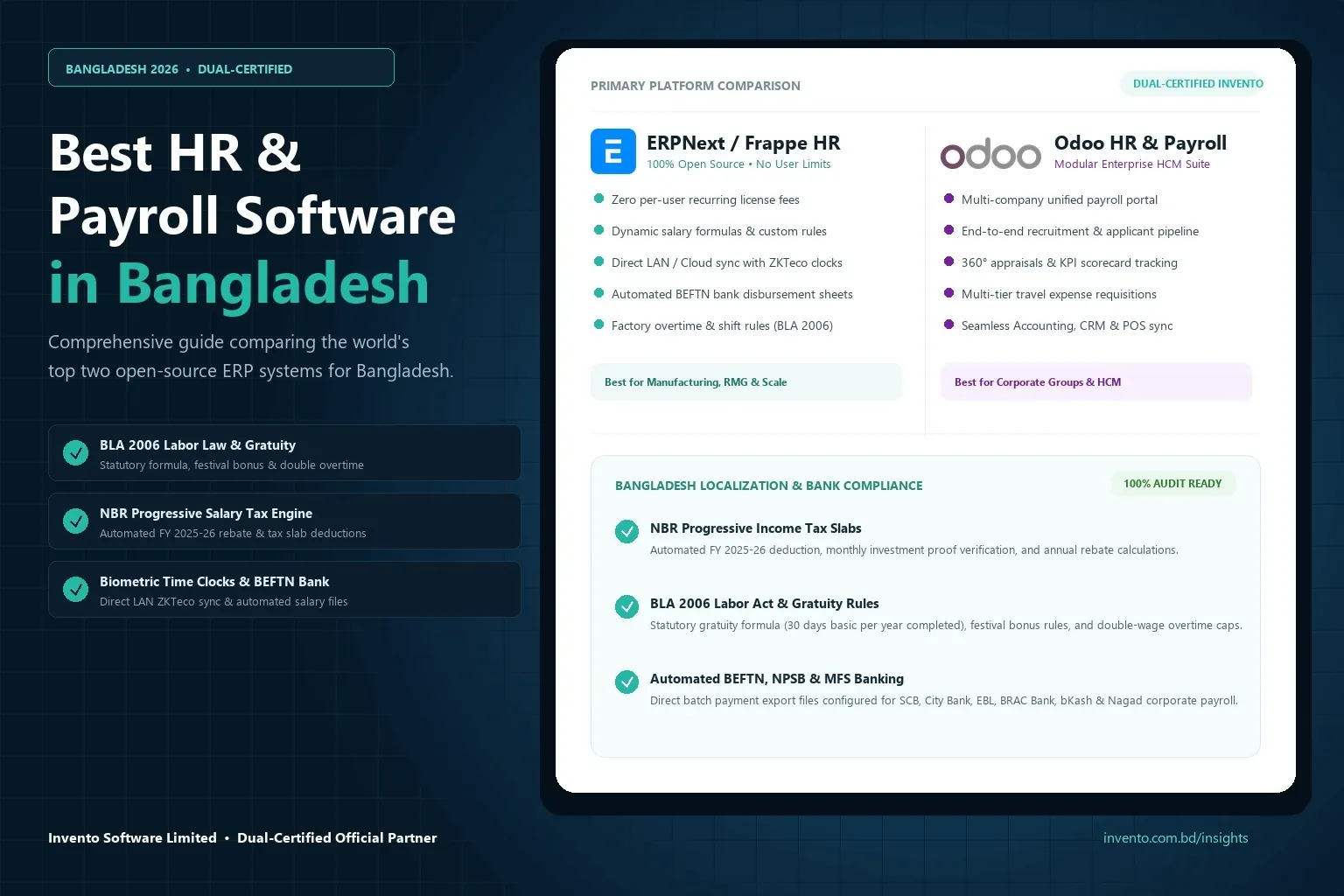
- Combined VDS & TDS Payroll Automation: In addition to vendor withholdings, corporations must deduct Tax Deducted at Source (TDS) on employee salaries under the Income Tax Act 2023. Explore our guide on the best HR and payroll software in Bangladesh and our breakdown of ERPNext HR & payroll modules to see how payroll taxes are automated.
- Severe Penalties for Non-Deduction: If an organization fails to deduct VDS or fails to deposit withheld taxes within the prescribed deadline, the company faces a mandatory 2% monthly interest penalty on the unpaid amount. Furthermore, under the Income Tax Act 2023, expenses where VDS/TDS was not properly withheld are fully disallowed as tax-deductible expenditures during corporate income tax assessments.
Input Tax Credit (Rebate) Rules: Maximizing Reclaims & Avoiding Disallowance
The Input Tax Credit (Rebate) mechanism prevents cascading “tax-on-tax” compounding by allowing registered manufacturers and service providers to offset the VAT paid on raw materials against the output VAT collected on commercial sales. However, claiming an input rebate requires strict compliance with statutory preconditions:
- 1. Valid Mushak 6.3 Invoice: The supplier must issue a legitimate, sequentially numbered Mushak 6.3 invoice bearing their active 13-digit BIN and matching your company’s registered BIN.
- 2. Banking Channel Payment Rule: Payments for purchases exceeding BDT 100,000 must be executed through banking channels (account payee cheque, bank transfer, or authorized commercial MFS). Cash payments for large invoices automatically disqualify the purchase from input tax rebate eligibility.
- 3. Submission of Mushak 4.3 Prior to Production: For manufacturers, no input tax rebate can be claimed on raw materials unless a statutory Input-Output Coefficient Declaration (Mushak 4.3) under Rule 21 was submitted to the Divisional VAT Officer prior to commercial supply.
- 4. Non-Rebatable Purchases: VAT paid on passenger vehicles (under 2,000 cc except for commercial rental fleets), office catering/entertainment, building construction materials for corporate head offices, and items purchased without proper tax invoices cannot be rebated.
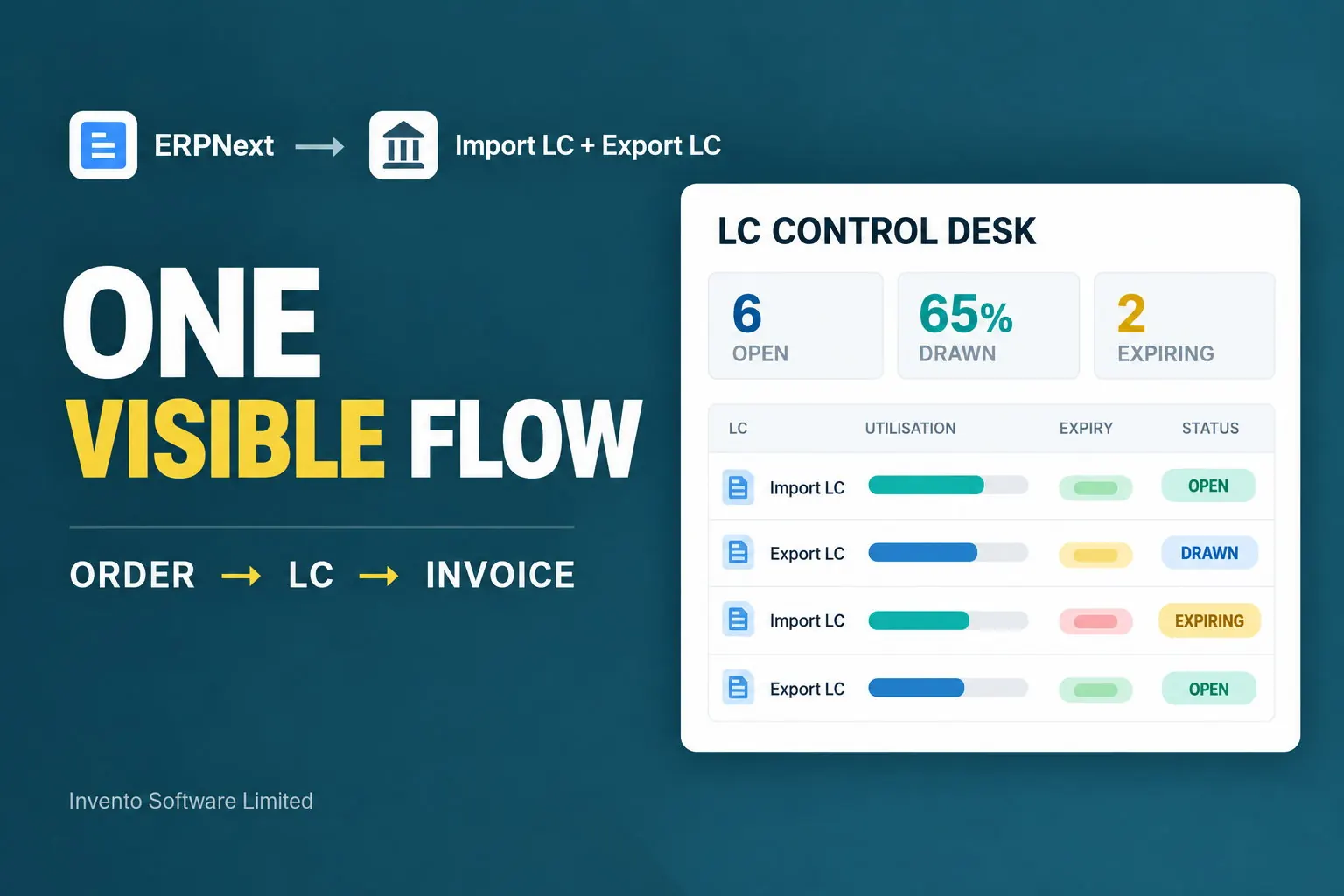
In an enterprise ERP, input tax rebate rules are programmed into the system’s ledger validation logic, preventing accountants from mistakenly booking unauthorized rebates that could trigger future audit liabilities. Learn how integrated workflows protect margins in our guide to the role of ERP in supply chain management and our analysis of import/export LC management in ERPNext.
Input-Output Coefficient (Mushak 4.3 & 6.4) for Manufacturers
For industrial factories, pharmaceutical plants, and food manufacturers, Mushak 4.3 (Input-Output Coefficient Declaration) under Rule 21 of the VAT & SD Rules 2016 is the operational linchpin of NBR compliance. The declaration details the precise quantity and value of raw materials, packaging, chemicals, and wastage percentages required to produce a single commercial unit of finished product. (For third-party job work and toll processing, businesses additionally issue Mushak 6.4 Contractual Production Challans under Rule 40).
Connecting ERP Bills of Materials (BOM) to Mushak 4.3:
In an ERPNext or Odoo manufacturing setup, the multi-level Bill of Materials (BOM) mirrors the NBR Input-Output Coefficient directly. When engineers update raw material ratios, change packaging dimensions, or adjust machine scrap tolerances, the ERP automatically flags the variance and prepares an amended Mushak 6.4 declaration. Discover industry-specific blueprints in our guides to the best ERP systems for manufacturing, ERP software for food manufacturing, and manufacturing ERP in Bangladesh.
How Automated ERP Solves VAT Compliance in Practice
Invento Software Limited provides a specialized Bangladesh VAT Localization Suite engineered for ERPNext and Odoo. The application replaces disconnected spreadsheets with an automated, tamper-proof compliance engine:
- 1. Centralized 13-Digit BIN Validation: Automatic checksum verification prevents clerical entry of fake or malformed tax identification numbers across customer and supplier records.
- 2. Point-of-Sale Real-Time Mushak 6.3 Generation: Cashiers at retail counters and warehouse dispatch bays print legally compliant Mushak 6.3 challans in seconds, complete with QR verification codes and sequential numbering. Explore our dedicated Invento POS system and retail architecture guide on ERPNext multi-store retail management.
- 3. Automated Mushak 6.6 Withholding Deductions: When accounting teams process vendor payment vouchers, the ERP calculates statutory VDS percentages based on the vendor’s service category, books the withholding liability, and prints the certificate with one click.
- 4. Real-Time General Ledger Integration: Every transaction updates dedicated NBR accounts: Input VAT Receivable, Output VAT Payable, VDS Payable, and Current Account with VAT Commissionerate. Learn more about customized accounting setups in our guide to top software companies in Bangladesh.
- 5. One-Click Mushak 9.1 Return Generation: At month-end, the ERP consolidates thousands of transactions into NBR’s 14-part return format, allowing finance controllers to reconcile and file returns within hours instead of weeks.
Penalties, Interest & Legal Consequences of Non-Compliance
The VAT and SD Act 2012 provides extensive punitive powers to NBR revenue officers under Section 85 for non-compliance. Understanding these legal risks underscores why manual spreadsheet tracking is unacceptable for commercial enterprises:
- Failure to Issue Mushak 6.3 Challan: Minimum penalty of BDT 10,000 to BDT 1,00,000 per violation, along with potential confiscation of commercial goods in transit.
- Failure to Maintain Statutory Registers (Mushak 6.1, 6.2, 6.2.1): Fixed monetary fines per unregistered accounting period, plus revocation of input tax rebate entitlements.
- Failure to File Monthly Return (Mushak 9.1) by the 15th: Mandatory BDT 10,000 late filing penalty for every missed month, with suspension of the company’s export-import utility permissions (bond license, IRC, ERC).
- Evasion and False Declarations: Treble penalty (300% of evaded tax), seizure of business premises, freezing of corporate bank accounts, and criminal prosecution of company directors.
Frequently Asked Questions (FAQ)
What is the mandatory threshold for VAT registration in Bangladesh?
Under current NBR regulations, businesses with an annual turnover exceeding BDT 3 Crore must register for a 13-digit BIN. Businesses with turnover between BDT 50 Lakh and BDT 3 Crore qualify for Turnover Tax at a flat 4% rate. Certain commercial activities—including importers, exporters, manufacturers of taxable goods, and specified service providers—must register for VAT regardless of their annual revenue.
When must a Mushak 6.3 tax invoice be issued?
A Mushak 6.3 tax invoice must be issued at the time or before the goods are delivered or supplied from factory premises, central warehouses, or retail counters. Moving goods without a valid Mushak 6.3 or Mushak 6.5 transfer challan constitutes illegal transport under Section 85 and is subject to immediate vehicle interception and cargo seizure by NBR customs and VAT intelligence.
How long can a company wait to claim an Input Tax Credit (Rebate)?
Under the VAT Act 2012, an Input Tax Credit must be claimed within the monthly return (Mushak 9.1) of the tax period in which the purchase invoice was issued, or within the immediate subsequent two tax periods (maximum 3 months). If a company fails to claim the rebate within this 3-month statutory window, the input credit expires permanently and cannot be recovered.
Does computerized accounting software require NBR certification?
Yes. Under NBR General Order No. 16/Mushak/2019, computerized accounting software used by registered enterprises must satisfy strict technical criteria, including immutable audit trails, sequential non-editable serial numbering, and automated sub-ledger generation. Invento Software Limited engineers ERPNext and Odoo implementations in full compliance with these NBR technical guidelines.
How does automated ERP prevent VDS non-compliance penalties?
An integrated ERP automatically identifies suppliers subject to withholding tax based on their service category, calculates the precise statutory withholding amount during payment voucher creation, holds the tax in a designated VDS liability account, and prints the official Mushak 6.6 certificate immediately—preventing costly monthly interest penalties and audit disallowances.
Next Step: Deploy NBR-Compliant ERP Automation
Eliminate VAT Audit Anxiety with Enterprise Compliance Automation
Protect your organization against audit penalties, automate sequential Mushak 6.3 invoices, and file accurate monthly Mushak 9.1 returns in hours. Partner with Invento Software Limited—the official certified ERPNext and Odoo partner in Bangladesh—to deploy an automated, NBR-compliant tax architecture.