Inventory is the financial lifeblood of every retail, wholesale, e-commerce, and manufacturing business. Without accurate stock control, companies risk losing capital to tied-up overstock or forfeiting sales to stockouts. Modern businesses increasingly replace manual spreadsheets with specialized inventory management software to automate tracking, streamline procurement, and protect operating margins.
Definition: What Is Inventory Management Software?
Inventory management software (IMS) is a centralized business tool that automates the tracking, ordering, storage, and sales allocation of goods throughout the supply chain. By recording stock movements in real time, it provides complete visibility over raw materials, work-in-progress, and finished goods across multiple warehouse locations, preventing costly stockouts and excessive holding costs.
Table of Contents
- How Inventory Management Software Works (4 Core Stages)
- Comparison: Spreadsheets vs. POS vs. Integrated ERP Inventory
- 7 Essential Features of Modern Inventory Software
- Inventory Valuation Methods: FIFO vs. Weighted Average
- Inventory Compliance in Bangladesh (NBR & Mushak 6.3)
- Choosing the Right Inventory System for Your Business
- Frequently Asked Questions (FAQ)
How Inventory Management Software Works: The 4-Stage Lifecycle
Modern inventory software tracks goods throughout their entire operational journey. Rather than relying on periodic manual audits, the system automatically logs transactions as stock moves through four continuous stages:
- Procurement & Receiving (Goods Receipt): When stock arrives from suppliers, warehouse personnel scan incoming shipments using mobile barcode scanners. The software reconciles delivery notes with the original purchase order (PO), logs quantities, and calculates landed costs (including shipping, customs duties, and local transport).
- Warehousing & Bin Allocation: Products are cataloged and assigned to specific aisles, bins, or warehouse zones. Systems generate unique SKUs, lot/batch numbers, and serial codes, enabling workers to locate inventory in seconds.
- Sales Allocation & Reservation: When an order is placed—whether across an in-store retail POS system, a B2B wholesale order, or an e-commerce storefront—the software instantly marks the required items as “reserved,” preventing accidental double-selling across channels.
- Fulfillment, Dispatch & Accounting Sync: Once packed and dispatched, delivery challans are generated. The system automatically reduces on-hand quantities, updates cost of goods sold (COGS) in the general ledger, and alerts managers if safety stock thresholds are breached.
Comparison: Spreadsheets vs. POS Inventory vs. Integrated ERP
Businesses often start tracking stock on Excel or Google Sheets. However, as SKU counts and transaction volumes expand, manual methods cause stock discrepancies, delayed reorders, and lost revenue. Here is how management approaches compare:
| Feature / Capability | Manual Spreadsheets | Basic POS Software | Integrated Cloud ERP/IMS |
|---|---|---|---|
| Stock Visibility | Delayed & manual | Real-time (single outlet) | Real-time (multi-warehouse) |
| Barcode & QR Support | None (manual typing) | Standard 1D checkout | Mobile 1D/2D + batch scanning |
| Multi-Location Transfers | High error rate | Limited or manual | Automated transfer orders |
| Batch & Expiry Control | Severe spoilage risk | Rarely supported | Automated FIFO & expiry tracking |
| Automated Reordering | No automated triggers | Basic low-stock alerts | Dynamic safety stock reorders |
| Bangladesh VAT (Mushak 6.3) | Manual paperwork | Basic invoice prints | Integrated NBR-compliant tax logs |
| Best Fit For | 1-person startups (<50 SKUs) | Single-store retail shops | Growing retailers, distributors, manufacturers |
7 Essential Features to Look for in Inventory Management Software
Selecting software that matches your operational complexity prevents costly migrations down the road. High-performing inventory systems deliver seven core capabilities:
1. Real-Time Multi-Location Visibility
If you operate multiple retail shops, showrooms, or central distribution warehouses, you need live stock counts across every location. Centralized visibility allows store associates to check if an out-of-stock item is available at a nearby branch, fulfilling orders through cross-warehouse transfers rather than losing customers to competitors.
2. Barcode, QR Code & Mobile Scanning
Manual data entry causes an estimated 1% to 3% error rate in inventory records. Barcode and QR code scanning eliminates typos during receiving, stocktaking, and picking. Modern solutions support smartphone camera scanning as well as industrial wireless handheld scanners, slashing audit times by over 70%.
3. Automated Reorder Points & Safety Stock Alerts
Rather than guessing when to reorder, intelligent systems calculate dynamic reorder levels based on average daily sales velocity and supplier lead times: (Lead Time Demand + Safety Stock = Reorder Point). When inventory dips below this threshold, the software automatically drafts purchase orders for supplier approval.
4. Serial Number & Batch/Lot Tracking
For electronics, pharmaceuticals, cosmetics, and food manufacturing, lot tracking is non-negotiable. Serial tracking records the warranty lifecycle of high-value electronics from purchase to warranty return. Batch tracking monitors expiration dates, ensuring items approaching expiration are prioritized for sale via First-Expired, First-Out (FEFO) rules.
5. Landed Cost Tracking & Multi-Currency Support
Imported inventory incurs customs tariffs, sea/air freight charges, port clearing fees, and local transport costs. Advanced platforms like advanced ERPNext inventory workflows apportion these expenses directly across shipment line items, ensuring true profit margins are calculated accurately rather than relying on raw factory purchase prices.
6. Seamless Point-of-Sale (POS) & Accounting Synchronization
Inventory software should never operate as an isolated silo. Connecting your warehouse database with Invento POS or small business POS software ensures that retail checkouts immediately deplete warehouse stock, while simultaneously posting Cost of Goods Sold (COGS) entries to your balance sheet.
7. Predictive Reporting, Stock Aging & Dead-Stock Analytics
Tying up working capital in slow-moving merchandise drains cash flow. Comprehensive analytics identify fast-moving winners (fast stock turnover) versus stagnant “dead stock” lingering past 90 days. Armed with aging reports, leadership can bundle, discount, or return dormant items before they turn into write-offs.
Inventory Valuation Methods: FIFO vs. Weighted Average
How you calculate the financial value of stock on your balance sheet impacts your reported profits and tax liabilities. Inventory software automates two recognized accounting methodologies:
- FIFO (First-In, First-Out): Assumes the oldest inventory items purchased are sold first. In inflationary environments, FIFO reports lower COGS and higher asset value on the balance sheet. It is standard for retail, perishables, and FMCG sectors.
- Moving Weighted Average: Recalculates unit cost every time new stock arrives at a different price point: (Total Cost of Existing Stock + Cost of New Batch) / Total Quantity. This smooths out price volatility and is widely utilized in wholesale distribution, hardware, and manufacturing.
Inventory Compliance in Bangladesh: NBR & Mushak 6.3 Standards
Operating a business in Bangladesh requires strict alignment with the National Board of Revenue (NBR) VAT guidelines under the VAT and Supplementary Duty Act. Inventory software plays an indispensable compliance role:
- Mushak 6.3 Tax Invoices: Goods cannot leave a warehouse or retail premise without a valid Mushak 6.3 delivery challan detailing items, HS codes, standard VAT rates (typically 15%), and recipient TIN/BIN numbers.
- Mushak 6.1 (Purchase Register) & Mushak 6.2 (Sales Register): Commercial distributors and manufacturers must maintain real-time input-output stock registers. Integrating an automated system eliminates manual bookkeeping discrepancies during NBR tax audits.
- Centralized Multi-Outlet Compliance: Companies managing multiple retail branches under a single central VAT registration (Central BIN) can explore our dedicated guide on Bangladesh VAT compliance for businesses.
Choosing the Right Inventory System for Your Business
Depending on your business scale and industry model, your ideal software architecture will fall into one of three tiers:
- Retail Counter & Fast Billing: For single or multi-outlet retail shops, boutiques, and restaurant operations, Invento POS delivers instant barcode checkouts, offline billing continuity, and live branch stock transfers.
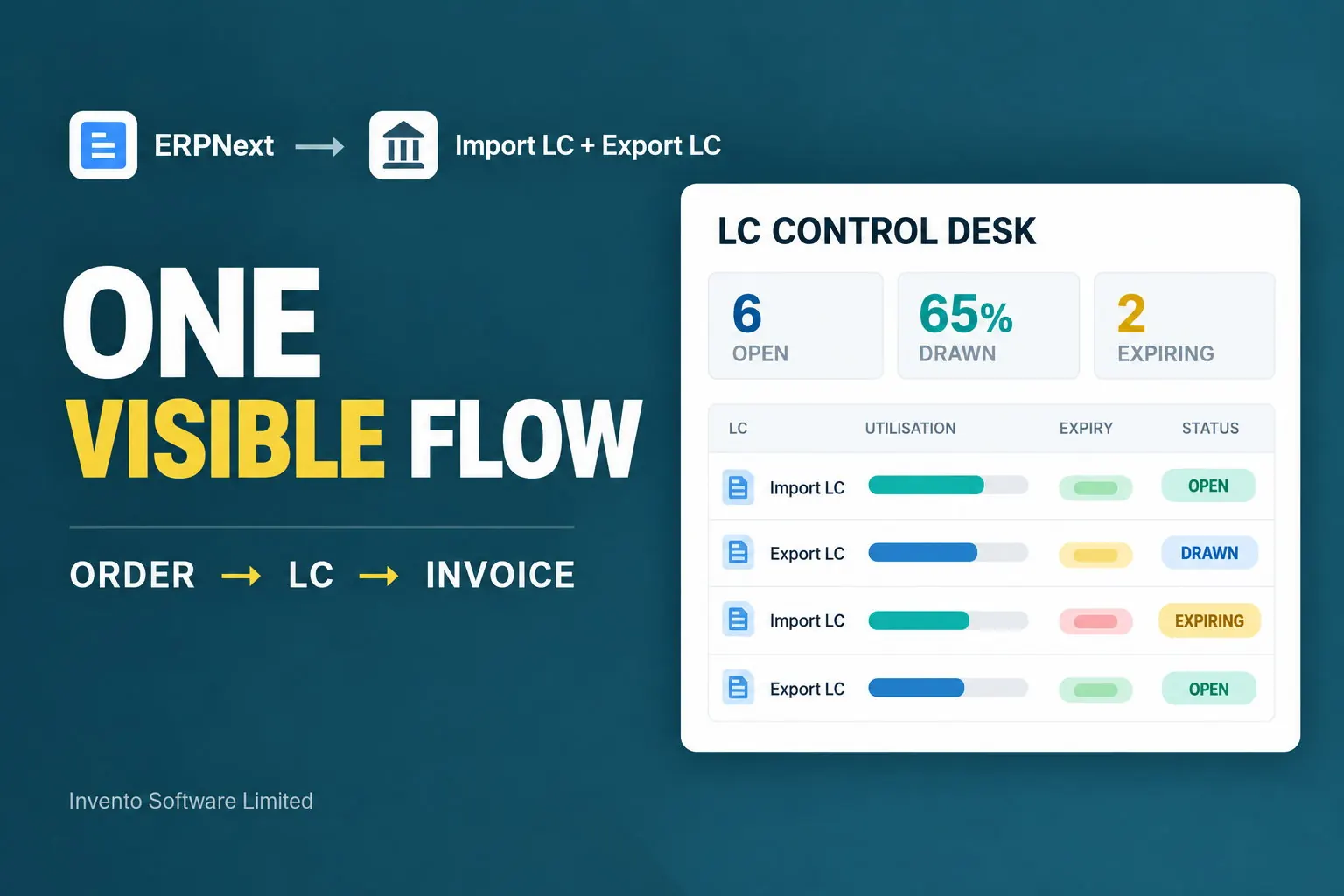
- Manufacturing, Import & Wholesale: For businesses managing complex bill of materials (BOM), raw material staging, and import LC documentation, our certified ERPNext implementation in Bangladesh provides end-to-end inventory traceability.
- Enterprise Supply Chain: For multi-company conglomerates requiring modular accounting, warehouse 3D routing, and CRM synchronization, Odoo ERP implementation offers unmatched flexibility.
Frequently Asked Questions (FAQ)
What is the difference between an IMS and a Warehouse Management System (WMS)?
An Inventory Management System (IMS) tracks what stock you have, how much is available, and when to reorder across all sales channels. A Warehouse Management System (WMS) focuses on how goods move inside a specific warehouse facility, optimizing physical put-away locations, picker travel routes, and packing stations.
Can small retail shops in Bangladesh use cloud inventory software offline?
Yes. Leading cloud inventory and POS solutions utilize local browser caching (IndexedDB) to allow cashiers to scan barcodes, generate receipts, and record sales even during internet outages. Once the connection is restored, all offline transactions sync automatically to the central cloud inventory.
How does inventory software prevent internal shrinkage and theft?
By enforcing role-based permissions, requiring supervisor authorization for stock adjustments, and logging every barcode scan to a specific user timestamp. Routine blind cycle counts quickly uncover discrepancies between theoretical digital stock and physical counts before losses escalate.
When is the right time to transition from spreadsheets to inventory software?
The transition is warranted when you manage more than 100 SKUs, operate across more than one location or sales channel, spend more than 5 hours per week reconciling stock counts, or experience recurring stockouts that hurt customer trust.