In an era of geopolitical turbulence, port bottlenecks, fluctuating fuel surcharges, and tightening commercial Letter of Credit (LC) regulations, modern supply chains can no longer run on disconnected spreadsheets and siloed communications. A modern Enterprise Resource Planning (ERP) platform functions as the central operational nervous system of supply chain management (SCM)—synchronizing demand forecasting, automated procurement, multi-warehouse logistics, customs clearance, and shop-floor manufacturing into one unified real-time workflow.
📦 Strategic SCM Takeaways for 2026:
- Mitigating the Bullwhip Effect: Real-time demand signals from customer orders flow directly upstream into raw material procurement, eliminating artificial order swings and stockouts.
- Import LC & True Landed Cost: Specialized ERP modules track customs duties, port demurrage, marine insurance, and C&F agent charges to accurately capitalize inventory valuation.
- End-to-End Traceability: Enforcing First-Expiry-First-Out (FEFO) and serialized batch tracking reduces perishable scrap and accelerates regulatory compliance audits.
- Specialized Implementation: Partnering with a premier enterprise integrator like Invento Software Limited guarantees tailored workflows for manufacturing, import-export, and multi-hub distribution.
1. How ERP Solves the Modern Supply Chain Crisis
Traditional supply chains suffer from information lag. When a retail customer purchases an item, that sales data might take weeks to reach warehouse inventory records, months to trigger a replenishment purchase order, and quarters to inform manufacturing plant production runs.
This lag creates the notorious Bullwhip Effect—where minor fluctuations in consumer demand become wildly exaggerated upstream, forcing suppliers to hold massive safety stocks or face catastrophic raw material shortages.
An integrated ERP system eliminates this latency. When a sales order is confirmed in your commercial system, the ERP immediately verifies available inventory, assesses in-transit shipments, checks Bill of Materials (BOM) availability, and triggers automated purchase requisitions. To understand the foundational mechanics of enterprise systems, explore our guide on What is ERP and How Does It Work?.
2. The 5 Core Pillars of SCM-Integrated ERP Architecture
Modern ERP software covers the entire supply chain lifecycle through five tightly synchronized operational pillars:
| SCM Pillar | Core ERP Module | Operational Workflow | Legacy Failure Mode | Business Impact |
|---|---|---|---|---|
| 1. Demand Planning & Forecasting | Material Requirements Planning (MRP II) | Historical sales velocity, seasonal trends, and open orders calculate precise raw material needs. | Gut-feeling ordering causing either crippling shortages or expensive overstocking. | Reduces inventory holding costs by 20% to 35%. |
| 2. Strategic Sourcing & Procurement | Purchase & Vendor Management | Automated RFQs, supplier scorecards, purchase order approval hierarchies, and contract price lists. | Maverick spending, unapproved vendor price hikes, and delayed reordering. | Cuts procurement cycle time by 45% and enforces strict spend compliance. |
| 3. Multi-Warehouse Inventory Control | Stock & Warehouse Management | Barcode/RFID scanning at GRN, putaway rules, bin location mapping, and FEFO batch rotation. | Phantom stock, misplaced pallets, and expired goods written off as dead loss. | Achieves 99.5% inventory record accuracy and eliminates picking errors. |
| 4. In-Transit Logistics & Transfers | Logistics & Delivery Management | Internal material transfer documents, in-transit warehouse tracking, dispatch notes, and proof of delivery. | Goods vanishing between central warehouses and regional retail branches. | Zero shrinkage during transit and total accountability across drivers and depots. |
| 5. Import/Export & LC Management | Commercial Trade & Landed Cost | Letter of Credit tracking, Bill of Lading, customs clearing, demurrage, and landed cost allocation. | Underestimating raw material costs due to unallocated customs duties and port charges. | 100% accurate product costing and gross margin visibility on imported items. |
For specialized insights into wholesale and supply chain distribution, explore Why ERP Software is Useful in the Bangladeshi Distribution Industry and see our tailored platform for ERPNext for Distribution Companies.
3. Demand Planning & The Material Requirements Planning (MRP) Cycle
At the heart of enterprise manufacturing and supply chain coordination lies the MRP engine. Rather than relying on guesswork, the ERP calculates procurement requirements through a rigorous multi-stage cascade:
- Independent Demand Ingestion: Sales orders, confirmed contracts, and AI-assisted predictive demand forecasts are compiled into a Master Production Schedule (MPS).
- Bill of Materials (BOM) Explosion: The ERP explodes each finished product into its hierarchical raw materials, sub-assemblies, and packaging components.
- Net Requirements Calculation: The system deducts physical warehouse stock, pending purchase orders, and allocated reserved stock to compute the true net requirement.
- Lead-Time Offset & Reorder Scheduling: Factoring in vendor manufacturing time and maritime shipping windows, the ERP schedules exact dates when purchase orders must be issued to ensure raw materials arrive just before production commences.
Discover how automated predictive tools revolutionize this process in our deep-dive on Demand Planning Software and explore our full range of Manufacturing ERP Software Solutions.
4. Import/Export & Letter of Credit (LC) Tracking in Bangladesh
For manufacturing and trading enterprises in Bangladesh, supply chain management is inseparable from international trade compliance. Importing raw materials (such as yarn for garments, chemicals for pharmaceuticals, or steel coils for industrial fabrication) involves complex banking Letters of Credit, regulatory vetting, and port logistics.
An integrated ERP solution tracks the entire commercial lifecycle:
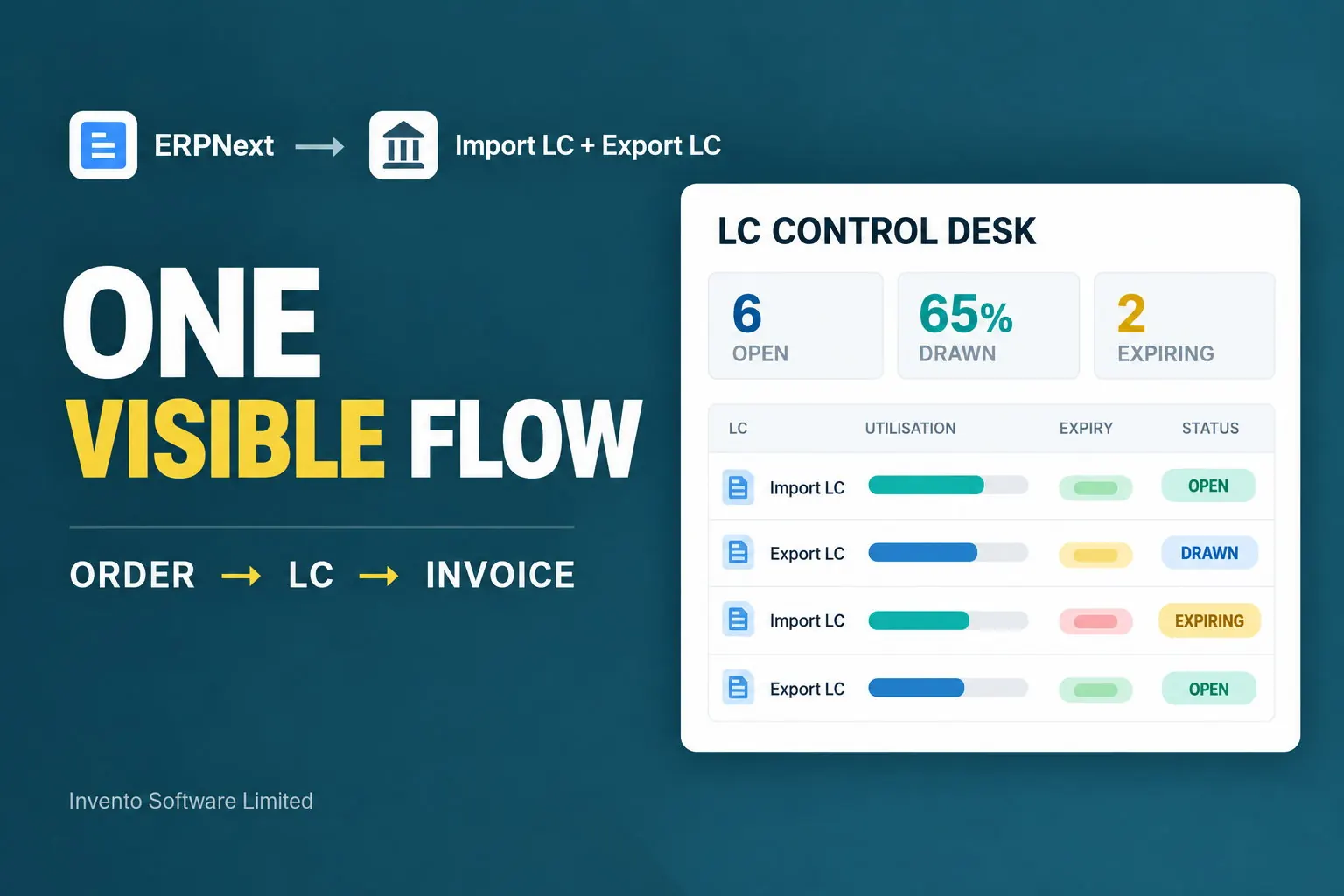
- LC Opening & Margin Tracking: Recording LC numbers, issuing bank details, margin percentages, and foreign currency exchange rates (USD/BDT/EUR).
- Shipping & Document Endorsement: Tracking Bill of Lading (B/L), Proforma Invoices (PI), Packing Lists, and Certificate of Origin documents.
- Port Clearance & Demurrage Prevention: Monitoring customs assessment notices, clearing agents (C&F), and demurrage deadlines at Chattogram Port or Kamalapur ICD.
- Landed Cost Capitalization: Automatically distributing all auxiliary expenses—customs duties, regulatory duty (RD), Advance Income Tax (AIT), VAT, clearing fees, and domestic freight—across the received inventory items proportionally based on value, quantity, or weight.
For a complete technical walkthrough on configuring commercial trade workflows, read our specialized guide on Import/Export & LC Management in ERPNext.
5. Multi-Warehouse Operations: FEFO, FIFO, and Barcoding
Managing stock across multiple physical locations requires absolute discipline. High-performing supply chain networks deploy rigorous inventory strategies enforced by ERP:
🏷️ First-Expiry-First-Out (FEFO) Automation
In pharmaceutical, food, and chemical industries, selling or processing old batches before they expire is critical. The ERP tags incoming raw materials with manufacturing and expiration dates. Pick lists automatically guide warehouse operators to the exact bin location containing the earliest-expiring batch, eliminating write-offs and scrap.
📦 Barcode & Mobile Scanner Warehouse Integration
Warehouse staff armed with handheld Android mobile terminals scan barcodes at Goods Receipt Notes (GRN), bin putaway, inter-warehouse transfers, and dispatch packing. This reduces human data entry error from 3% to less than 0.01%. Learn more in our article on What is Inventory Management Software.
Connecting these warehouse operations directly into front-line retail outlets ensures complete end-to-end supply synchronization. Discover how this operates in ERP for Retail Business: Complete 2026 Guide.
6. Industry-Specific Supply Chain Blueprints
Different vertical sectors exhibit wildly divergent supply chain requirements. An enterprise ERP platform must adapt to these specific sector dynamics:
- Food & Beverage Manufacturing: Requires strict temperature-controlled storage tracking, recipe formulation, lot tracing for emergency recalls, and perishability analytics. Discover our specialized solution for ERP Software for Food Manufacturing.
- Construction & Heavy Infrastructure: Procurement is project-based. Materials (cement, rebar, structural steel) must be ordered against specific milestone budgets and delivered directly to job sites. Explore ERP Software for Construction Industry.
- Textile & Ready-Made Garments (RMG): Tracks complex fabric roll inspection (4-point system), trim stores, cut-to-pack ratios, and production line balancing across sewing floors. Read our analysis on the Best ERP System for Manufacturing and industrial deployments in Manufacturing ERP Bangladesh.
7. The Executive SCM Dashboard: 4 Critical Metrics
In 2026, supply chain directors monitor live operational metrics through centralized ERP dashboards:
| Key Metric | Formula / Definition | Industry Benchmark | How ERP Optimizes It |
|---|---|---|---|
| On-Time In-Full (OTIF) | % of customer orders delivered by promised date with complete requested quantities. | > 95% for top-tier distributors | Automates pick-pack-ship schedules and alerts dispatch managers of shipping delays. |
| Inventory Turnover Ratio (ITR) | Cost of Goods Sold (COGS) ÷ Average Inventory Value. | 6 to 12 turns / year depending on sector | Identifies deadstock, auto-adjusts safety stocks, and accelerates stock movement. |
| Supplier Defect Rate | Rejected items upon Quality Inspection ÷ Total Received Units. | < 0.5% for strategic vendors | Enforces mandatory Quality Inspection (QI) at GRN before releasing vendor payments. |
| Cash-to-Cash Cycle Time | Days of Sales Outstanding (DSO) + Days of Inventory (DIO) − Days Payables (DPO). | < 30 to 45 Days | Synchronizes payables and customer collections to maximize operating liquidity. |
8. Automated VAT & Tax Compliance in the Supply Chain
In Bangladesh, supply chain transactions trigger statutory VAT obligations at every handoff: procurement VDS (VAT Deducted at Source), Mushak 6.3 invoices on delivery, Mushak 6.5 documents for inter-depot stock transfers, and Mushak 6.1 purchase registers.
A modern ERP platform automates this entire compliance chain, ensuring that every goods receipt and dispatch updates statutory registers in real time. Read our comprehensive guide on Bangladesh VAT Compliance & Automation.
9. Why Invento Software Limited is Your Trusted Supply Chain ERP Partner
Implementing an enterprise supply chain ERP requires seasoned solution architects who understand both complex software engineering and physical factory logistics. As the leading ERP integration firm in Bangladesh, Invento Software Limited provides end-to-end supply chain transformation:
🌐 Certified ERPNext & Odoo Integrators
Official partners for ERPNext Bangladesh and Odoo ERP Bangladesh with proven multi-plant deployments.
🚢 Custom Import LC & Customs Modules
Pre-built integrations for commercial banking, foreign currency hedges, landed cost allocation, and port clearance workflows.
📱 Mobile Barcode & Warehouse Apps
Equip floor operators with custom handheld scanning apps that update inventory instantaneously over local Wi-Fi or cellular networks.
⚙️ Full-Cycle Change Management
On-site user training for warehouse keepers, procurement officers, and plant managers to guarantee 100% adoption.
Transform Your Supply Chain with Modern ERP in 2026
Gain complete visibility over your procurement, inventory, customs clearance, and distribution. Speak with our senior enterprise supply chain consultants today.
10. Frequently Asked Questions (FAQ)
What is the difference between SCM software and an ERP system?
Supply Chain Management (SCM) software focuses specifically on external logistics, supplier collaboration, and freight routing. An ERP system is a comprehensive operational platform that integrates SCM capabilities directly with internal accounting, human resources, shop-floor manufacturing, and financial reporting, eliminating data silos between logistics and corporate finance.
How does an ERP system prevent the “Bullwhip Effect”?
ERP eliminates the Bullwhip Effect by sharing real-time point-of-sale customer demand directly with upstream procurement and manufacturing modules. Suppliers and factory planners base production on actual consumption velocity rather than distorted, batch-inflated purchase orders from intermediate middlemen.
How does ERP calculate the true Landed Cost of imported items?
Through a Landed Cost Voucher (LCV), the ERP captures auxiliary charges—ocean freight, customs assessment duties, marine insurance, and clearing agent commissions—and allocates them across the received items based on their value, weight, or volume. This ensures inventory ledgers reflect the true delivered cost of raw materials.
Can ERP handle First-Expiry-First-Out (FEFO) batch tracking?
Yes. Advanced ERP systems enforce FEFO batch tracking by assigning unique batch numbers and expiration dates at goods receipt. When picking lists or material transfers are generated, the system automatically routes staff to select the oldest valid stock, drastically reducing expired inventory loss.