Executive Summary (2026 Enterprise Guide): Odoo ERP (formerly OpenERP and TinyERP) is a globally recognized, open-core enterprise resource planning suite built on Python and PostgreSQL. With over 12 million users worldwide, Odoo provides an integrated ecosystem of more than 30 official business applications and 40,000+ community modules covering CRM, accounting, inventory, manufacturing (MRP), human resources, and point of sale. Available in both a 100% free open-source Community Edition and an expanded commercial Enterprise Edition, Odoo enables expanding enterprises to unify front-office sales pipelines with back-office supply chains on a modern, modular architecture. As an official certified partner for Odoo in Bangladesh, Invento Software Limited delivers localized implementations with automated NBR Mushak VAT compliance and zero recurring license fees for qualified open-source deployments.
On This Page: The Complete Guide to Odoo ERP
- What Is Odoo ERP? Architectural Overview & Open-Core Model
- 2026 Master Comparison: Odoo Community vs. Odoo Enterprise vs. HubSpot vs. SAP
- Head-to-Head Breakdown: Odoo vs. HubSpot vs. Zoho vs. Bitrix24
- Core Odoo Functional Modules Explained
- Odoo vs. ERPNext: Which Open-Source Platform Fits Your Business?
- Odoo Hosting Architecture: Cloud vs. Odoo.sh vs. On-Premises
- The 5-Stage Odoo Implementation Roadmap
- Total Cost of Ownership (TCO): Community vs. Enterprise Licensing
- Frequently Asked Questions (FAQ)
- Next Step: Schedule a Certified Odoo ERP Consultation
What Is Odoo ERP? Architectural Overview & Open-Core Model
At its technical foundation, Odoo is a modular business management software suite operating on a unified relational database schema. Unlike legacy enterprise software suites that were assembled through decades of corporate acquisitions—resulting in clumsy middleware bridges, disparate interfaces, and brittle data synchronizations—Odoo was engineered from the ground up as a single, coherent application stack.
Odoo’s technical architecture is built on three core pillars:
- 1. Object-Relational Mapping (ORM) in Python: Business logic, security access rules, and automated workflow triggers are written in clean, maintainable Python code, allowing rapid custom module development.
- 2. PostgreSQL Transaction Engine: All modules read from and write to an enterprise-grade ACID-compliant PostgreSQL database, guaranteeing strict financial data integrity even during high-frequency retail transactions.
- 3. Responsive Web & OWL Client: Users interact with a lightning-fast single-page web application powered by Odoo’s proprietary Odoo Web Library (OWL), delivering a modern, intuitive user experience across desktop monitors, warehouse barcode terminals, and mobile devices.
To explore how modern businesses adopt modular ERP infrastructure, review our guide on what is ERP and how does it work and discover the top six features that differentiate Odoo from other ERP solutions.
2026 Master Comparison: Odoo Community vs. Odoo Enterprise vs. HubSpot vs. SAP
Choosing the right software stack requires understanding how Odoo’s open-core editions compare against proprietary CRM and enterprise ERP suites:
| Feature Dimension | Odoo Community | Odoo Enterprise | HubSpot CRM | SAP Business One |
|---|---|---|---|---|
| Software License Fee | BDT 0 (100% Free Open Source LGPLv3) | ~$24 – $38 / user / month | $50 – $150+ / user / month | $100 – $250+ / user / month + server fee |
| Functional Scope | Full ERP (Core CRM, Sales, Invoicing, Stock, Basic MRP) | Full Enterprise ERP + Studio, Barcode, Full Accounting, Mobile App | Front-Office Only (Marketing, CRM, Customer Support) | Full Traditional ERP (Finance, Manufacturing, Distribution) |
| Double-Entry Accounting | Invoicing & basic payments (Extended with Invento modules) | Full dynamic financial statements, bank sync & auto-reconciliation | Non-Existent (Requires QuickBooks or Xero sync) | Full institutional double-entry financial suite |
| Manufacturing (MRP) | Standard BOM & Manufacturing Orders | Work centers, routing, maintenance scheduling & quality check points | None | Deep industrial discrete manufacturing MRP |
| Customization Speed | Fast (Python code & open API) | Very Fast (Odoo Studio drag-and-drop + Python) | Moderate (Limited to CRM workflow triggers) | Slow (Expensive specialized consultants required) |
| Bangladesh Fiscal VAT | Invento NBR Mushak 4.3/6.3/6.6 localization module | Invento NBR Mushak 4.3/6.3/6.6 localization module | None (Requires third-party billing connectors) | Custom local partner development (High add-on cost) |
Head-to-Head Breakdown: Odoo vs. HubSpot vs. Zoho vs. Bitrix24
One of the most frequent procurement questions encountered by fast-scaling businesses is comparing Odoo against pure-play CRM platforms like HubSpot, Zoho, and Bitrix24:
- HubSpot: Outstanding for inbound lead magnets, marketing email automation, and sales pipeline drag-and-drop. However, HubSpot is not an ERP. It cannot track physical inventory across warehouses, manage manufacturing work centers, or generate general ledger balance sheets. To run an enterprise on HubSpot, you must buy and integrate third-party accounting and inventory tools, leading to brittle sync bridges and data duplication.
- Zoho One: An extensive suite of 45+ applications. However, Zoho is built as dozens of separate applications connected by API webhooks rather than a single database schema. Changes in Zoho CRM can experience latency before reflecting in Zoho Books or Zoho Inventory. Odoo operates on a single PostgreSQL relational database with zero sync lag.
- Bitrix24: Strong in internal team collaboration, task management, and communication feeds. However, its inventory and manufacturing capabilities are rudimentary and lack industrial MRP scheduling and double-entry general ledger depth.
- Odoo’s Unified Advantage: Odoo delivers full CRM capabilities while binding them directly to warehouse stock reservations, purchase orders, factory work orders, and statutory accounting ledgers without any middleware. Compare options in our comprehensive reviews of Odoo for SMEs and Odoo vs. SAP for SMEs.
Core Odoo Functional Modules Explained
Odoo’s modular architecture allows companies to begin with core applications and activate additional modules as business operations scale:
1. Odoo Accounting & Bangladesh Tax Localization
Odoo’s accounting engine automates multi-currency general ledger accounting, automated bank statement feeds (OFX/QIF/CSV), and smart reconciliation models that match customer payments to open invoices using AI heuristics. For companies in Bangladesh, Invento provides native localization automating NBR Mushak 6.3 invoices, Mushak 6.6 VDS certificates, and statutory withholdings. Read our complete guide to the Odoo accounting module and discover our manual on Bangladesh VAT compliance and management.
2. Odoo Double-Entry Inventory & Multi-Warehouse Logistics
Odoo treats inventory like double-entry bookkeeping: stock is never created or destroyed; it merely moves between physical locations, partner locations (vendors/customers), and virtual locations (inventory adjustments/scrap). This ensures 100% auditability across multi-depot distribution networks. Features include automated reordering rules (min/max), batch and serial tracking, First-Expired, First-Out (FEFO) shelf-life rotation, and mobile barcode terminal scanning. Explore how modern supply chains run on ERP in our guide to ERP in supply chain management.
3. Odoo Manufacturing (MRP) & Shop-Floor Control
For discrete and process manufacturers, Odoo bridges design and production. It handles multi-level Bills of Materials (BOM), work center routings, overall equipment effectiveness (OEE) tracking, preventive machine maintenance, and automated scrap accounting. Discover industrial blueprints in our guides on manufacturing ERP software, manufacturing ERP in Bangladesh, and ERP for food manufacturing.
4. Odoo CRM, Omnichannel Sales & Touchscreen POS
Odoo CRM manages leads with Kanban stage tracking, automated email marketing, and VoIP phone integration. For retail chains and restaurants, the integrated Odoo Point of Sale (POS) operates directly in any web browser and continues functioning even during internet dropouts, syncing sales data automatically when connectivity restores. Learn more about retail solutions in our guide to multi-store retail management and explore the Invento POS platform.
5. Odoo Integrated E-Commerce & Online Portals
Unlike standalone e-commerce platforms (like WooCommerce or Shopify) that require third-party inventory sync plugins, Odoo E-Commerce is natively connected to your ERP database. When a customer orders online, inventory reserves instantaneously in the designated warehouse, customer credit limits update, and payment gateway receipts balance automatically. Explore custom web integrations engineered by customized software solutions.
6. Odoo Human Resources, Attendance & Payroll
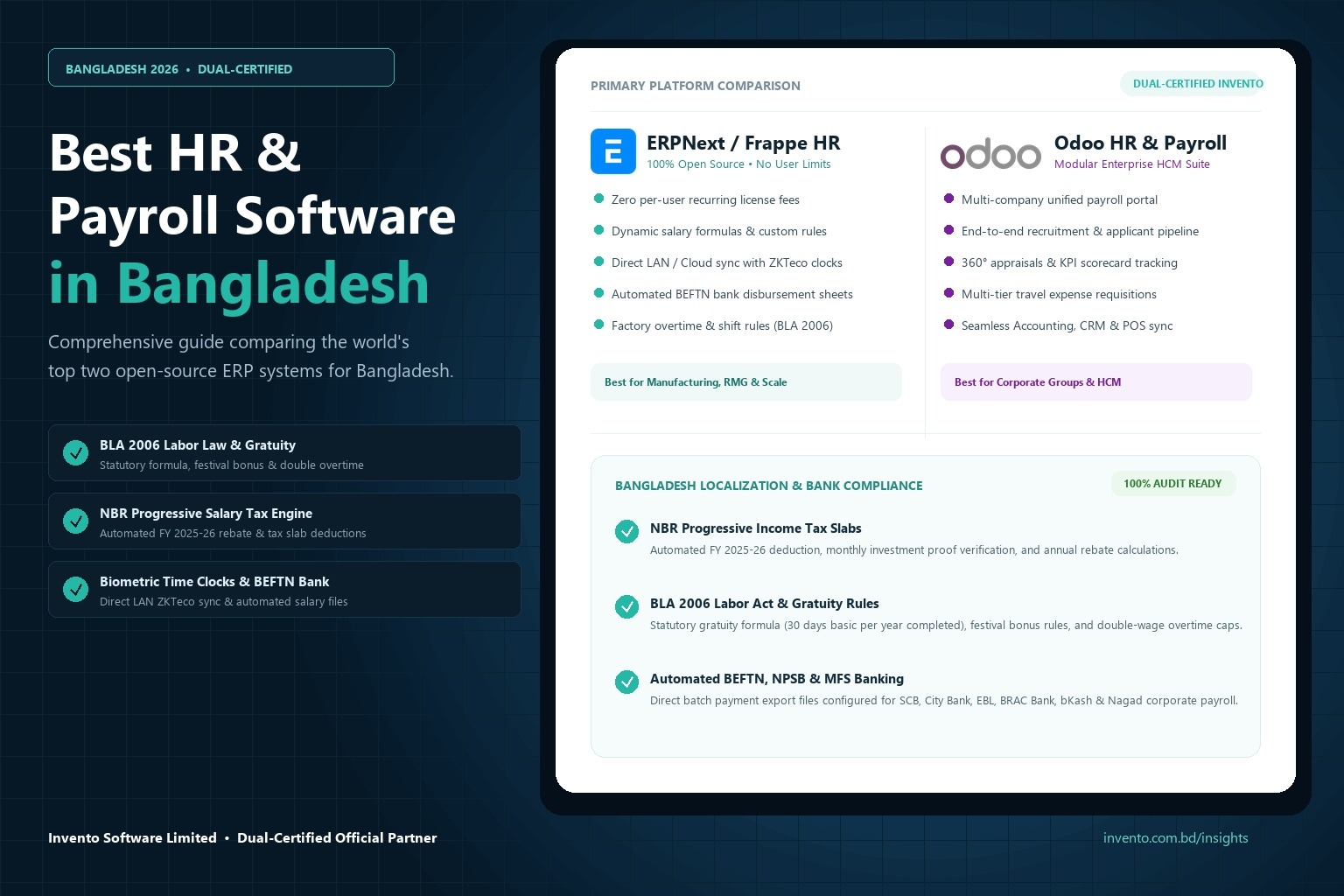
Odoo HRM manages employee contracts, biometric attendance synchronization, paid leave approvals, performance evaluations, and expense claims. In Bangladesh, Invento configures salary structures aligned with the Bangladesh Labor Act 2006 (BLA), calculating statutory overtime, festival bonuses, and provident fund deductions. Discover how to evaluate HR software in our review of the best HR & payroll software in Bangladesh and our breakdown of ERPNext HR & payroll modules.
Odoo vs. ERPNext: Which Open-Source Platform Fits Your Business?
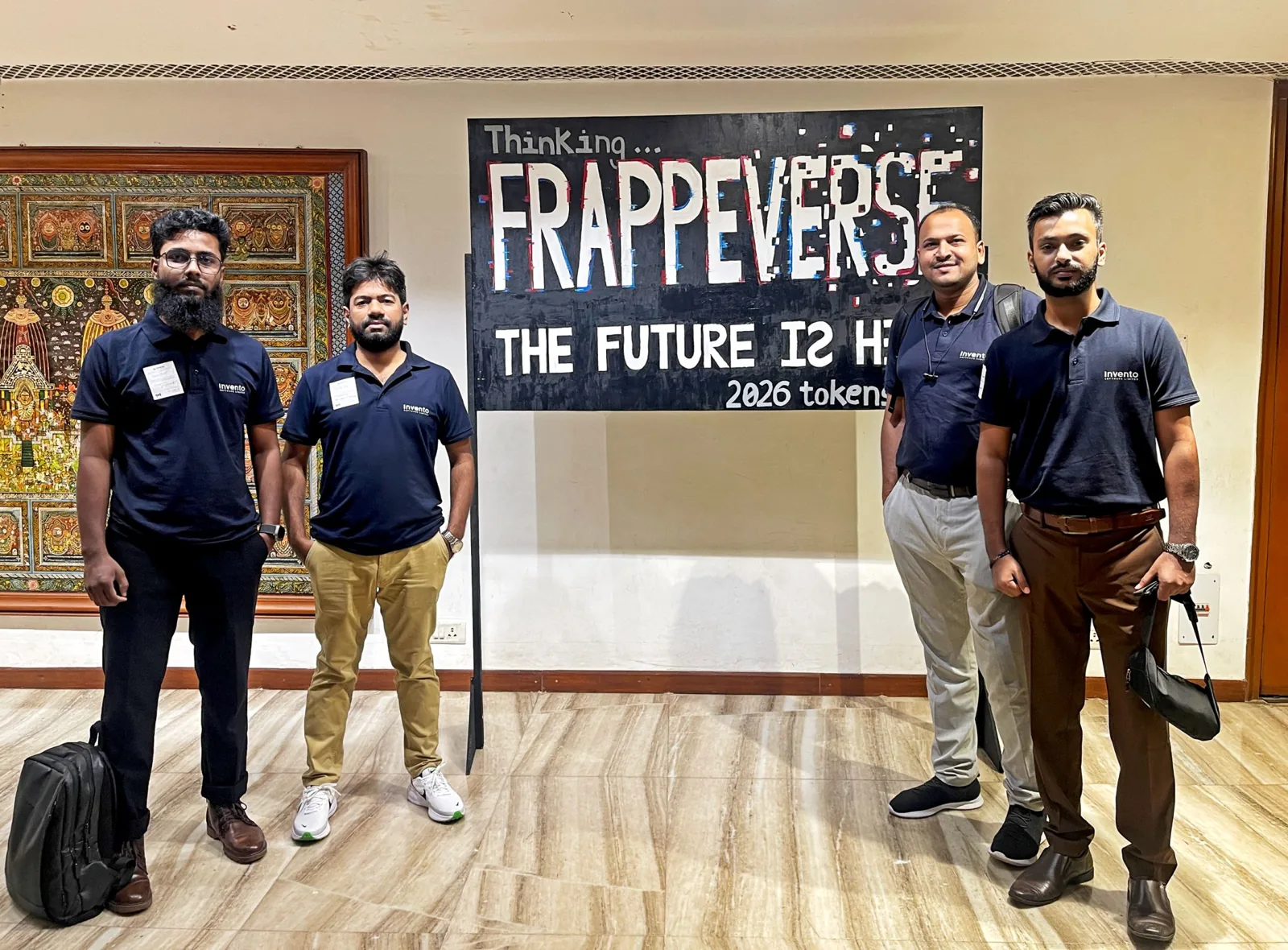
As the official dual certified partner for both platforms in Bangladesh, Invento provides objective guidance on choosing between Odoo and ERPNext:
- Choose Odoo If: You require a visually dynamic user interface, visual Kanban-driven sales and CRM pipelines, complex retail point-of-sale setups, or access to the world’s largest marketplace of 40,000+ third-party modules.
- Choose ERPNext If: You want a 100% open-source core where all advanced modules (full double-entry accounting, complete manufacturing routing, and HR payroll) are freely included without an “Enterprise” paywall, built on the clean, rapid-development Frappe Framework. Compare both platforms in detail in our comprehensive ERPNext vs. Odoo evaluation.
Odoo Hosting Architecture: Cloud vs. Odoo.sh vs. On-Premises
Odoo offers three distinct deployment architectures to balance control, cost, and maintenance:
- 1. Managed Private Cloud (AWS / DigitalOcean / Domestic Data Centers): Invento deploys and manages your Odoo instance on high-performance cloud servers with automated daily backups, SSL hardening, and 99.9% uptime guarantees. Ideal for organizations seeking maximum privacy and performance. Read why cloud ERP software is essential for modern business scaling.
- 2. Odoo.sh (Cloud Platform for Developers): Odoo’s official PaaS environment integrating automated GitHub testing branches, continuous integration (CI/CD), and staging instances. Best for companies with in-house developers customizing Odoo Enterprise.
- 3. On-Premises Physical Servers: Deployed directly on company-owned server racks inside factory premises or corporate headquarters for total physical isolation.
The 5-Stage Odoo Implementation Roadmap
A successful ERP rollout requires disciplined project governance. At Invento Software Limited, our certified implementation architects execute a structured 5-stage deployment framework (detailed in our guide on ERP implementation best practices):
- Business Discovery & Gap Analysis: Auditing your current operational workflows, pain points, and reporting requirements against standard Odoo modules.
- Architecture & Custom Module Engineering: Configuring Chart of Accounts, warehouse locations, and developing custom Python modules for unique business logic.
- Master Data Cleansing & Migration: Sanitizing, formatting, and migrating legacy customers, suppliers, inventory items with barcodes, and opening financial balances.
- User Acceptance Testing (UAT) & Role Training: Department heads execute full operational test cycles in a staging sandbox while end-users receive hands-on SOP training.
- Go-Live Cutover & Dedicated Hypercare: Supervised launch with on-site engineering support ensuring seamless real-time operations from day one.
Total Cost of Ownership (TCO): Community vs. Enterprise Licensing
Understanding the true financial commitment of an ERP deployment requires evaluating both software licensing and professional services:
Financial Reality of Odoo Deployment:
For businesses opting for Odoo Community, recurring software licensing fees are completely eliminated (saving an organization with 100 users over BDT 3,000,000 every year compared to SAP or proprietary SaaS). Capital is invested exclusively in professional configuration, custom report development, and secure cloud hosting. For enterprises requiring Odoo Enterprise, Invento assists in optimizing user tiers to maximize ROI. Discover why top software companies in Bangladesh recommend open-source enterprise models and review the future of ERP in 2026.
Frequently Asked Questions (FAQ)
Is Odoo ERP software completely free to use?
Odoo Community Edition is 100% free and open-source under the LGPLv3 license. Businesses can download, host, and customize it without paying any software license fees. Odoo Enterprise is a commercial upgrade that includes additional proprietary modules (Odoo Studio, mobile apps, advanced accounting) and requires an annual per-user subscription.
Can Odoo handle Bangladesh NBR VAT compliance (Mushak 6.3)?
Yes. Invento Software Limited provides a dedicated Bangladesh fiscal localization module for Odoo. The system automatically validates 13-digit BINs, generates sequential NBR Mushak 6.3 tax invoices, prints Mushak 6.5 transfer challans, and computes Mushak 6.6 VDS withholding certificates in full compliance with NBR regulations.
What is the primary difference between Odoo and HubSpot?
HubSpot is primarily a marketing automation and sales pipeline CRM; it does not handle inventory management, factory production (MRP), supply chain procurement, or general ledger accounting. Odoo is a comprehensive ERP system that unifies front-office CRM with complete back-office warehouse, manufacturing, and financial execution in a single database.
Can Odoo Point of Sale (POS) function offline?
Yes. The Odoo POS application runs inside any web browser and leverages local browser caching. Cashiers can continue processing sales, scanning barcodes, and printing customer receipts during internet outages. Once the network connection is restored, Odoo automatically syncs all offline transactions with the central server.
How long does an Odoo ERP implementation take?
For small to mid-market companies adopting core sales, purchasing, inventory, and accounting, an implementation typically takes 6 to 10 weeks. Multi-branch enterprises, large manufacturing plants, or organizations requiring extensive third-party integrations typically complete deployment within 12 to 18 weeks.
Next Step: Schedule a Certified Odoo ERP Consultation
Transform Your Enterprise Operations with Certified Odoo Implementation
Streamline multi-branch operations, automate supply chains, and eliminate disconnected software silos. Partner with Invento Software Limited—the official certified Odoo partner in Bangladesh—to design an enterprise architecture built for sustainable scale.